
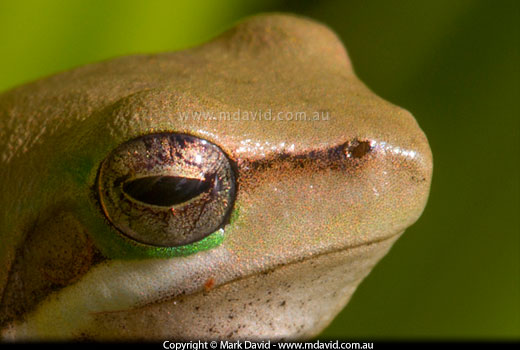
A high pixel density combined with an APS-C camera’s framing came in handy photographing this little guy — an Eastern Dwarf Tree Frog.
Imagine you had a camera that captured zillions of megapixels. You could step outside your front door, take a snap, and then spend hours zooming in on the image on your computer to get the shot you wanted. You wouldn’t need a zoom lens because you could simply zoom in onscreen.
Does that sound like science fiction? It should. Because science fiction is pretty much what it is. Imagining for a second that you could even build a camera with so many megapixels you’d need almost infinitely good lenses and camera technique to capture so much distant detail without just recording a whole lot of blur. And distance haze would make everything on the horizon pretty much invisible anyway.
But you get the idea: by having more pixels in your sensor you can capture more detail for zooming in onscreen later.
This, combined with tight framing, is at the heart of why some APS-C cameras can capture distant imagery in a way that matches some of the full-frame cameras.
Before I go on, I’m assuming you know what I mean by APS-C versus full frame, especially in how the APC-C crops the sides off images in a way that’s similar to using a longer lens. But don’t worry if you don’t, because I explain that stuff in this article. So from now on, I’ll assume you have a basic idea about the differences.
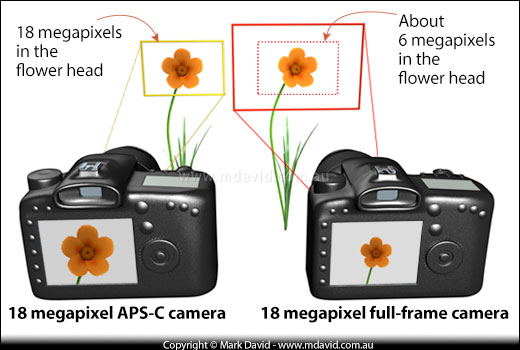
Have a look at the graphic below, showing an APS-C camera alongside a full-frame camera. In this example, both cameras have sensors with the same number of megapixels. So in this case, the APS-C camera is using all of its 18-megapixels to capture just the top of the flower, while that same portion of the flower is only captured by some of the 18 megapixels of the full-frame sensor. In this example, the APS-C would capture detail in that flower head in a way that the full-frame camera can’t match, and so it really is like having a longer lens.
Now compare that with the next example (below). This time the APS-C camera only has 6 megapixels in its sensor compared with 18 megapixels in the full-frame. That changes things a lot.
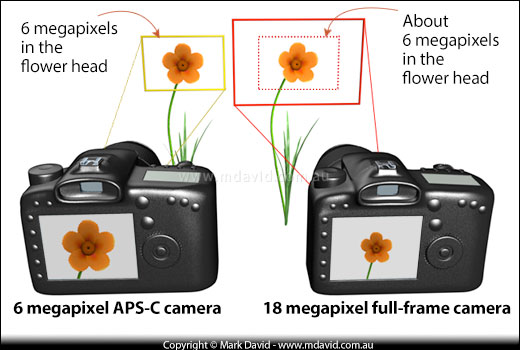
Even though it’s still using all of its megapixels to capture the top portion of the flower, what it gets is more than matched by what’s recorded by the full-frame camera thanks to the full frame having so many more megapixels.
You see, the sensors in full-frame cameras are (very rough guide) about 2 and a half times bigger than their APS-C cousins. So if the full-frame camera sensor also has two and a half times more pixels in it, then the APS-C camera is really not giving you an advantage. Both cameras in this example would be capturing the top portion of the flower with about 6 megapixels, while the full-frame camera would record a lot of extra stuff around the sides as well. So you would be able to take a picture using the full-frame camera, crop off the outside bits of it and you end up with pretty much the same as what the APS-C camera got.
That’s why the density of pixels plus the size of the sensor, combine to determine what real advantage you get with the multiplier effect in cropped-sensor cameras.
Back to the article about APS-C versus full frame
Sure. There are advantages in big megapixel counts. But there are disadvantages too. It all really depends on how much you want them.
Copyright © Mark David. All rights reserved


